Plush Moon and Star Fabric Images: A Practical Evaluation for Designers and Makers
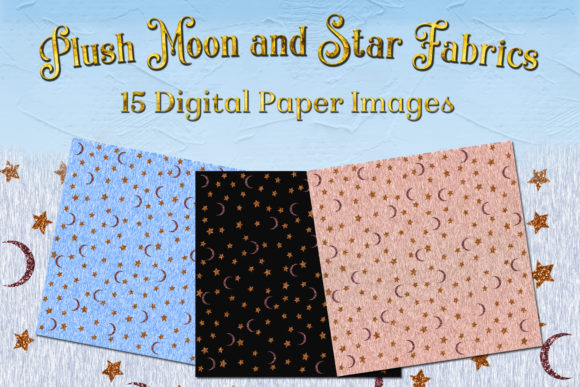
Plush Moon and Star Fabric Images is a curated digital collection of 15 high-resolution fabric pattern images—each featuring stylized moons and stars rendered with intentional texture, depth, and tonal nuance. Unlike generically generated or flat vector-based motifs, this set emphasizes tactile realism: the stars appear as dark gold accents embedded in soft, woven-like grounds, while the moons carry a subtle metallic rose lilac sheen that shifts gently under light. These aren’t clipart or repeating tiles—they’re standalone, compositionally balanced fabric swatches designed to evoke materiality, not just graphics.
What Sets This Collection Apart From Other Digital Fabric Resources
Most digital fabric libraries fall into one of two categories: seamless tile patterns optimized for infinite repetition (common in web design or print-on-demand platforms), or photographic swatches captured under studio lighting but often lacking consistent resolution, color fidelity, or intentional palette cohesion. Plush Moon and Star Fabric Images occupies a middle ground—it delivers fixed-dimension, non-tiling fabric images with deliberate aesthetic continuity across all 15 files.
The technical specifications reinforce its utility: each image is a 2500×2500px JPEG at 300 PPI, meaning it scales cleanly for physical output up to roughly 8.3×8.3 inches at print resolution. That makes it viable for mockups of small textile goods—pillows, pouches, baby blankets—or layered digital composites where texture authenticity matters. The ZIP package contains no additional software, licensing tiers, or usage restrictions beyond standard commercial use—simplifying integration into existing workflows.
Color Palette Considerations and Real-World Consistency
The 15 included colors—Beige, Blue, Cream, Dark Blue, Non-metallic Gold, Light Green, Maroon, Near-Black, Pink, Purple, Red, Rose, Non-metallic Silver, Dark Teal, and White—are selected not just for visual range but for functional harmony. Each background supports the dual motif without overwhelming contrast or muddying the metallic accents. Notably, the Near-Black variant uses a distinct fabric base to preserve depth; it avoids the flatness that can occur when pushing RGB values too close to #000000 in textile simulation. This attention to substrate variation reflects an understanding that perceived color depends on both pigment and surface behavior—a nuance often missing in algorithmically adjusted palettes.
For designers evaluating consistency across projects, this means fewer surprises during color correction or print calibration. If you’re building a cohesive product line—say, a seasonal bedding capsule or gift set—the uniform rendering across hues reduces the need for manual tone-matching between assets.
When Plush Moon and Star Fabric Images Fits—and When It Doesn’t
This set excels in scenarios where control, predictability, and aesthetic specificity outweigh flexibility. It’s well-suited for:
- Branded merchandise development — When you need consistent, licensable fabric visuals for pitch decks, client presentations, or pre-production sampling.
- Digital textile prototyping — Especially for makers using tools like Adobe Photoshop or Affinity Photo who prefer working with high-res raster assets rather than generating patterns from scratch.
- E-commerce mockup refinement — Because each image is square and centered, it integrates cleanly into templates for pillow covers, tote bags, or wall hangings without cropping guesswork.
However, it has clear boundaries. If your work demands seamless tiling—for wallpaper design, large-format fabric printing, or scalable UI backgrounds—this set won’t serve that need without manual editing. Likewise, if you require SVG or vector formats for embroidery digitizing or laser-cutting guides, these JPGs would need conversion and likely lose fidelity in the process. There’s also no transparency layer or alpha channel; overlays must be handled via blending modes or masking in post-production.
Comparison With Alternative Approaches
Some designers opt to photograph their own fabric samples—a valid approach when authenticity and exact material match are critical. But that requires access to physical swatches, controlled lighting, color-calibrated capture gear, and time for post-processing. Plush Moon and Star Fabric Images offers a time-efficient alternative when those resources aren’t available or when early-stage ideation calls for rapid visual exploration.
Others rely on AI-generated textile patterns. While increasingly capable, such outputs often lack repeatable consistency across variations—e.g., a “gold star” may shift hue or scale unpredictably between prompts. In contrast, this collection delivers identical motif treatment across all 15 colors, reducing decision fatigue during selection.
There’s also the option of commissioning custom digital fabric art. That provides full ownership and bespoke direction—but at significantly higher cost and lead time. Plush Moon and Star Fabric Images sits pragmatically between off-the-shelf generic assets and fully custom creation: it gives you professional-grade execution without requiring negotiation, briefing, or revision cycles.
Practical Integration Tips for Different Use Cases
If you’re using these images for social media content—say, Instagram posts promoting handmade goods—consider pairing a single fabric image with minimalist typography and a neutral backdrop. The inherent richness of the plush texture helps anchor otherwise sparse layouts. Because the motifs are subtle rather than bold, they avoid competing with product photography when used as secondary visual elements.
For print projects, test one file first. While 300 PPI at 2500×2500px is sufficient for many applications, verify how the metallic rose lilac and dark gold render on your target printer and paper stock—especially with near-black or deep maroon backgrounds, where ink density can affect perceived shimmer. Some printers reproduce metallic tones more faithfully with coated matte papers than uncoated cotton rag.
In digital design tools, leverage layer blending options. Overlaying a soft light or overlay mode on top of the fabric image can enhance the impression of raised texture without distorting the underlying color balance. Avoid heavy sharpening filters, which tend to exaggerate JPEG compression artifacts around fine motif edges.
Decision Factors to Keep in Mind
Before choosing Plush Moon and Star Fabric Images, ask yourself:
- Do I need precise, ready-to-use fabric visuals—or am I still exploring broad stylistic directions? If the latter, free or low-cost pattern generators might suffice for initial moodboarding.
- Is motif consistency across colors important to my project’s identity? If yes, this set’s unified treatment becomes a functional advantage—not just aesthetic preference.
- What’s my output medium? For web-only use, even lower-resolution versions would work; for physical products, the 300 PPI resolution ensures fidelity without overloading file sizes unnecessarily.
- How much post-production time am I willing to invest? These files are production-ready, but they’re not infinitely adaptable. Adjustments like recoloring or motif repositioning require raster editing skill and may impact perceived quality.
It’s also worth noting that while the palette includes 15 distinct colors, it doesn’t cover every possible variation—there’s no true black, no neon spectrum, and no pastel gradients. That’s not a shortcoming, but a design choice aligned with the collection’s emphasis on grounded, livable tones suitable for interior-facing or wearable textiles.
Final Perspective
Plush Moon and Star Fabric Images isn’t positioned as a universal solution—it’s a focused tool for specific stages of textile-related work. Its value lies in its reliability, its attention to material nuance, and its avoidance of unnecessary complexity. For professionals weighing options between DIY photography, AI generation, stock subscriptions, or custom commissions, it represents a measured middle path: affordable, immediate, and intentionally crafted. Whether it’s the right choice depends less on what it *is* and more on what your current project asks of it—clarity of purpose, consistency of execution, and respect for how real fabric behaves in light and space.