Wizards Party: A Thoughtful Pattern Resource for Professional Design Projects
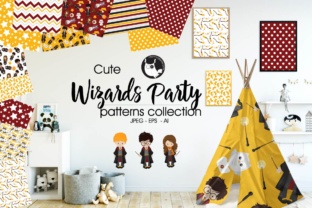
Wizards Party is a cohesive, high-fidelity pattern background design set built specifically for creators who need visual consistency without sacrificing charm or polish. It’s not a broad-themed clipart bundle or a generic “magic”-labeled collection—it’s a tightly curated set of interlocking, scalable graphic elements grounded in thoughtful composition and intentional color harmony. What distinguishes Wizards Party from similar offerings is its balance of thematic personality and professional utility: it delivers whimsy with precision, making it viable for both playful branding and refined editorial applications.
What You Actually Receive—and Why It Matters
The package includes three core deliverables: one EPS vector file, one native Adobe Illustrator (.ai) file, and individually saved hi-res 300 DPI JPEGs for each graphic element. This combination supports real-world production needs across platforms and workflows. The EPS ensures compatibility with older or non-Adobe software—useful for print vendors, packaging designers, or educators using legacy systems. The .ai file preserves layers, swatches, and editable paths, enabling quick customization in Illustrator-based studios or agencies where asset reuse and adaptation are routine. The standalone JPEGs serve as immediate drop-in assets for presentations, social media templates, or CMS-based layouts where vector support isn’t available or practical.
Each pattern component—whether a floating wand, a stylized cauldron, a crescent moon motif, or a subtle starburst—is drawn with clean anchor points, consistent stroke weights, and balanced negative space. There’s no visual clutter or inconsistent line quality between elements. That level of attention translates directly into reliability during scaling, color replacement, or integration into larger compositions.
Design Quality and Consistency
Unlike many themed pattern sets that rely on heavy textures, exaggerated shadows, or inconsistent perspective, Wizards Party uses flat, modern vector styling with carefully calibrated spacing and rhythm. The patterns repeat cleanly without visible seams—even when tiled at large scale for wall graphics, fabric mockups, or presentation backdrops. Color palettes are limited to six harmonious tones (deep indigo, warm gold, soft lavender, muted sage, cream, and charcoal), all defined as named swatches in the Illustrator file. This makes global adjustments—such as shifting from a daytime palette to a twilight variant—fast and predictable.
Typography isn’t included, but the patterns are designed with ample breathing room around focal motifs, allowing safe placement of body text or headlines without masking or distortion. In practice, this means Wizards Party works well behind newsletter headers, course module dividers, or product packaging panels where legibility must remain uncompromised.
Practical Flexibility Across Use Cases
Wizards Party functions most effectively when used as a structural design layer—not just decoration. For example:
- Marketing teams have applied it to webinar slide decks and email campaign banners, using the gold-and-indigo variants to reinforce brand warmth while maintaining visual distinction from competitors’ overused gradient or minimalist templates.
- Educators and course creators use individual elements (e.g., the compass-like star chart or ink-bottle icon) as section dividers in LMS interfaces or printable worksheets—scaling them up for posters or down for badge icons without loss of clarity.
- Small business owners incorporate the seamless background patterns into Shopify store banners and product labels, particularly for niche offerings like artisanal teas, fantasy-themed stationery, or indie board games—where tone and cohesion matter more than literal representation.
It’s less effective as a primary identity system (e.g., a logo or full brand guideline suite), nor does it replace custom illustration. But as a supporting visual language—especially in projects where time, budget, or technical constraints limit bespoke development—it delivers measurable efficiency gains.
Who Benefits Most—and When
Professionals who regularly produce branded collateral under tight deadlines tend to gain the most from Wizards Party. Think freelance designers managing multiple clients, marketing coordinators building internal campaign assets, or content creators developing digital products like Notion templates or Canva course kits. Its strength lies in reducing decision fatigue—not just saving time. With clearly labeled layers, logical grouping, and intuitive naming conventions (e.g., “Wand_Small_Variant2.ai”), users avoid the common friction of reverse-engineering poorly organized files.
It’s also well-suited for teams using collaborative tools like Figma or Adobe XD, where SVG exports from the Illustrator file can be imported and styled via CSS variables or design tokens. Educators integrating design literacy into curriculum find value in the clean vector construction—it serves as a tangible reference for teaching path editing, color theory application, or pattern logic.
That said, Wizards Party assumes baseline familiarity with vector editing. Beginners may need 20–30 minutes to orient themselves to the layer structure before adapting elements confidently. And while the color palette is versatile, it doesn’t include neon, pastel, or high-contrast variants—so projects requiring those moods would need supplemental recoloring or blending modes.
Long-Term Usability and Integration
The assets hold up well over repeated use. Because they’re built in vector format with no embedded raster effects or transparency traps, they retain fidelity across output formats—from screen displays to offset-printed brochures. Users report minimal degradation even after multiple rounds of export, edit, and reimport—particularly when preserving the original Illustrator file as the source of truth.
One practical observation: the seamless tile dimensions (2400 × 2400 px for JPEGs; scalable vectors) align closely with standard digital canvas sizes used in social media and presentation tools. That means less manual cropping or resizing before deployment—a small but meaningful workflow win.
For long-term projects—like an ongoing blog series or multi-phase product launch—Wizards Party provides enough variation (four distinct pattern arrangements, plus 12+ standalone icons) to maintain visual interest without straining consistency. It avoids the “sameness fatigue” common with overly repetitive pattern libraries, yet remains unified enough to feel intentional rather than piecemeal.
A Realistic Recommendation
If your work involves recurring need for cohesive, theme-aligned backgrounds or decorative accents—and you value clean construction, cross-platform compatibility, and time-efficient customization—Wizards Party is a sound investment. It won’t replace custom illustration, nor does it aim to. Instead, it fills a specific, frequently overlooked gap: reliable, expressive pattern infrastructure that respects both creative intent and production reality.
It’s especially worth considering if you’ve previously spent hours sourcing, cleaning, and unifying free vector assets—or if you’ve abandoned promising themes due to poor scalability or inconsistent style. Wizards Party removes those friction points without demanding a steep learning curve or locking you into proprietary formats. What you get is what you use: no subscriptions, no watermarks, no usage restrictions beyond standard commercial license terms.
For professionals balancing creativity with delivery discipline, Wizards Party functions less like a “theme pack” and more like a quietly capable design partner—one that shows up prepared, stays out of the way, and delivers exactly what was promised.