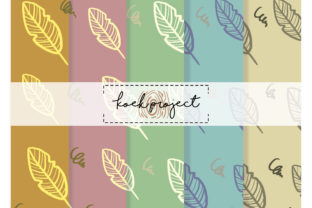
Floating Feather Pattern Pack
There’s a quiet shift happening across design workflows—away from over-polished, algorithmically generated assets and toward textures, motifs, and patterns that feel intentionally human. The Floating Feather Pattern Pack arrives right in the center of that movement: a curated set of hand-drawn feather motifs designed not just to decorate, but to resonate. It’s not about adding “feathers” as a cliché—it’s about embedding lightness, movement, and organic rhythm into branding, editorial layouts, packaging, or digital interfaces where authenticity matters more than ever.
Why Hand-Drawn Feathers Stand Out Today
In an era where AI image generators can produce thousands of “feather” variations in seconds, what makes a hand-drawn feather motif valuable isn’t rarity—it’s intentionality. Each line in the Floating Feather Pattern Pack carries subtle variation: slight tapering at tips, gentle curvature in shafts, irregular barb spacing. These aren’t flaws—they’re cues our eyes recognize as human-made. That distinction matters when viewers scroll past dozens of visuals in under a minute. A hand-drawn feather doesn’t shout; it invites closer looking. It signals care—not just in execution, but in curation.
This aligns with broader shifts in consumer and professional expectations. Designers, marketers, and small business owners increasingly avoid stock-looking elements—not because they’re outdated, but because they no longer communicate distinctiveness. When a boutique skincare brand uses a floating feather pattern on product labels or email headers, it subtly reinforces values like airiness, natural ingredients, and mindful self-care—without needing explanatory copy.
How This Pattern Fits Real Creative Workflows
The Floating Feather Pattern Pack includes five JPG and five PNG files—each built for flexibility, not friction. That balance between simplicity and utility reflects how modern creators actually work: rarely starting from scratch, but rarely settling for one-size-fits-all either.
- JPG files offer fast, lightweight integration for web banners, social media templates, or printed mockups where transparency isn’t required.
- PNG files preserve clean edges and alpha channels—ideal for layering over photos, applying to apparel mockups, or building branded slide decks where the feather motif needs to sit naturally atop varied backgrounds.
Consider a freelance illustrator designing a workshop workbook on creative resilience. Instead of spending hours drawing custom dividers, they drop in a floating feather PNG as a subtle section break—soft, thematic, and consistent across 40 pages. Or a yoga studio owner updating their newsletter template: a single feather pattern applied as a watermark behind text adds texture without competing for attention. No plugin, no licensing ambiguity—just immediate, respectful visual language.
From Trend to Tool: What’s Changed in Pattern Use
Patterns used to be background noise—literally. Think of early web design: tiled repeats, often low-res, serving only to fill space. Today, patterns function more like typography: they carry tone, pace, and hierarchy. A floating feather motif doesn’t just “fill” a background—it suggests direction (upward lift), weight (feathery lightness), and continuity (repetition as rhythm).
This evolution is tied to platform behavior. With rising mobile usage and faster content consumption, designers rely less on complex illustrations and more on repeatable, scalable motifs that retain clarity at any size. The Floating Feather Pattern Pack delivers exactly that: each file is high-resolution, optimized for both retina displays and print-ready output up to 12" × 12" at 300 DPI. There’s no guesswork about scaling or cropping—just predictable, consistent application.
Practical Use Across Industries and Roles
The versatility of this pack isn’t theoretical—it’s observable in how real users apply it:
- Educators use the feather motifs in printable reflection journals or classroom posters—softening academic visuals without sacrificing professionalism.
- Bloggers and content creators embed them as watermarks on original photography or as decorative borders around quote graphics, reinforcing a personal aesthetic without distracting from the message.
- Small business owners apply them to invoice headers, packaging tape designs, or thank-you cards—small touches that elevate perceived value without increasing production cost.
- UX designers test feather-based loading animations or subtle hover states in dashboards where soft motion improves perceived performance—even if actual load time hasn’t changed.
What ties these uses together isn’t the feather itself, but how it behaves: non-intrusive, scalable, emotionally coherent. It doesn’t demand interpretation—it supports meaning already present in the content.
Authenticity Without the Overhead
“Authentic” is one of the most misused words in creative marketing—but in practice, it often comes down to consistency of craft and clarity of intent. The Floating Feather Pattern Pack avoids the trap of faux-rustic or artificially distressed aesthetics. Its authenticity lies in its origin: drawn by hand, scanned cleanly, preserved without over-smoothing or auto-tracing. That means no uncanny valley effect—no moment where a viewer pauses and thinks, “That line feels too perfect.”
For professionals managing tight deadlines or limited design resources, that reliability is practical, not philosophical. You don’t need to justify why a hand-drawn element fits your brand voice—you simply know it does, because the line quality matches the warmth of your copy, the openness of your layout, or the breathability of your color palette.
What to Keep in Mind When Using It
Even elegant tools benefit from thoughtful application. Here are grounded recommendations—not rules, but observations based on real usage:
- Start with contrast, not coverage. Try using one feather motif as a focal point—centered on a cover, placed in the corner of a presentation slide—before expanding to full repeats. Let it breathe first.
- Test across contexts. A feather pattern that reads beautifully on a matte brochure may feel too busy on a glossy product box. Preview in both RGB (digital) and CMYK (print) environments if possible.
- Pair with restrained typography. Feathers imply lightness—so avoid heavy, tightly spaced fonts nearby. Open sans-serifs or delicate serifs tend to harmonize best.
- Respect scale hierarchy. If using multiple feather files in one project, vary size—not style. A large-scale feather as a hero graphic and a tiny version as a bullet point creates cohesion without repetition fatigue.
None of these require advanced software knowledge. They’re refinements you notice after using the pack two or three times—not instructions you memorize before downloading.
Looking Ahead—Without Overpromising
Will hand-drawn pattern packs replace generative tools? No. But they’ll continue occupying an essential niche: the space between fully automated and fully custom. As creative tools become more accessible, the value of intentional, human-scaled assets grows—not because they’re rare, but because they’re reliable anchors in unpredictable workflows.
The Floating Feather Pattern Pack doesn’t solve every design challenge. It won’t build your website or write your brand story. What it does do is offer ten clean, cohesive, ready-to-use expressions of lightness—each one drawn, not rendered. In a world that moves faster every year, sometimes the most useful thing you can download is something that simply feels like it belongs.