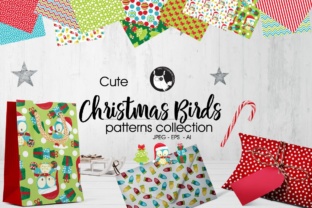
Christmas Birds Pattern Collection
Imagine wrapping your holiday newsletter in feathered charm, designing a greeting card that feels like a winter woodland, or launching a boutique product line where every label sings with seasonal warmth—without lifting a single vector anchor point. That’s the quiet power of Christmas Birds: a thoughtfully crafted set of festive avian motifs grounded in authenticity, not cliché.
This isn’t just another clipart bundle. Christmas Birds delivers a cohesive, high-fidelity pattern background design centered on stylized yet recognizable birds—robins, cardinals, blue jays, and snowfinches—rendered with delicate linework, subtle texture, and balanced negative space. Each element breathes; none overwhelm. The palette leans into traditional holiday tones (crimson, forest green, deep navy, cream), but with enough tonal nuance to work equally well in minimalist branding or rich editorial layouts.
What You Actually Get—No Surprises, Just Usability
The deliverables are streamlined for real-world use—not theoretical flexibility:
- 1 EPS Vector File — Fully scalable, print-ready, and compatible across Adobe Creative Suite, CorelDRAW, Affinity Designer, and most professional layout tools. Ideal for large-format signage, packaging die-lines, or embroidery digitizing prep.
- 1 Adobe Illustrator (.ai) File — Layered, named, and editable. Colors are built with global swatches. Paths are clean and simplified—not auto-traced noise. You can recolor a robin in two clicks, isolate a branch motif, or adjust spacing without breaking alignment.
- Individual hi-res JPEGs (300 DPI) — Each bird, wreath, berry cluster, and supporting element saved separately. No cropping required. Drop them straight into Canva, PowerPoint, Mailchimp templates, or Shopify product pages—and retain crisp detail even at 8" x 10".
No hidden raster layers. No locked assets. No “bonus” files you’ll never open. Just what professionals need: precision, portability, and control.
Where Christmas Birds Fits Into Real Workflows
It’s easy to assume seasonal graphics belong only in December—but Christmas Birds shines year-round because its strength lies in versatility, not expiration dates.
For educators and publishers: Use individual bird elements to illustrate phonics units (“B is for Blue Jay”), create classroom borders that feel intentional (not cutesy), or build inclusive holiday readers that emphasize nature over religion. One elementary curriculum designer told us she replaced generic “winter clipart” with these birds in her literacy kits—and saw measurable improvement in student engagement during read-aloud time. Why? Because kids recognized the species. They asked questions. The art invited curiosity, not distraction.
For freelancers and small studios: This set cuts client revision cycles. When a café owner requests “something festive but not tacky” for their December menu board, you drop in a subtle diagonal pattern using the cardinal motif—scaled to 12% opacity—then overlay menu text in clean sans-serif. Done in under 15 minutes. No custom illustration fee. No stock license ambiguity. And because the .ai file is layered, you can swap out a robin for a snowfinch in under a minute if the client prefers “more quiet energy.”
For e-commerce and product creators: Think beyond wrapping paper. These birds translate beautifully to fabric prints (scarves, tea towels), enamel pin mockups, ceramic decals, and even laser-etched wood ornaments. A maker in Portland uses the EPS file to generate CNC toolpaths for birch plywood bird coasters—scaling the vector to exact millimeter tolerances without pixelation. Another used the JPEGs as seamless tile patterns in Shopify’s theme editor, creating a branded “holiday shop” banner that loads instantly on mobile.
Design Integrity Matters—Here’s How It Shows Up
Look closely at the wing feathers on the cardinal. Notice how the stroke weight varies slightly—not randomly, but to suggest light catching contour. Observe the spacing between berries on the holly sprig: consistent rhythm, not mechanical repetition. That’s intentional craftsmanship. It’s why this set avoids the “clipart fatigue” that makes so many holiday assets feel disposable.
These aren’t traced photos. They’re drawn with purpose—proportionally accurate enough to read as real birds, stylized enough to function as graphic shorthand. That balance means they hold up at thumbnail size on Instagram, scale cleanly to billboard dimensions, and retain legibility when printed on textured kraft paper.
Practical Considerations Before You Use It
Not every project needs every file—but knowing which one to reach for saves time:
- Use the .ai file when you need to adapt color, combine elements, or integrate into an existing brand system (e.g., swapping out the default crimson for your brand’s signature burgundy).
- Reach for the EPS when prepping for commercial printers, sign shops, or vendors who don’t use Adobe software—or when you need guaranteed CMYK output with spot-color support.
- Pull the individual JPEGs for fast social posts, email headers, blog illustrations, or any context where vector support isn’t available (or necessary). Their 300 DPI resolution ensures sharpness—even when stretched across a full-width website hero section.
Also worth noting: the pattern background design is built as a true repeat—no visible seams, no awkward gaps. But it’s not forced symmetry. There’s gentle variation in bird placement and orientation, mimicking organic arrangement. That subtle irregularity is what keeps viewers from subconsciously scanning for “the break”—a common fatigue trigger in rigid tile patterns.
If you're evaluating multiple holiday design sets, ask yourself: Does it allow me to say something specific—not just “it’s Christmas,” but “this is warm, grounded, and quietly joyful”? Does it give me room to edit, not just insert? Does it respect the intelligence of my audience—whether they’re five-year-olds spotting birds on a worksheet or designers choosing assets for a luxury candle brand?
Christmas Birds answers yes—to all three. It doesn’t shout. It invites. And in a world saturated with visual noise, that kind of restraint isn’t just refreshing—it’s functional.